Late Payment Reminder Templates for Cleaners (Free UK Download)
It is 9pm. You cleaned for them on Monday. The invoice went out on Tuesday. It is now the following week, nothing has arrived, and you are staring at your phone wondering whether a second message makes you look desperate.
You are not being unreasonable. You did the work. They owe you money. The only problem is that you do not know what to say.
This free late payment reminder kit gives you the exact words: four ready-to-send messages, in WhatsApp and email versions, plus a simple routine for when to send them and a tracker so nothing slips through.
At a Glance
Inside the free Late Payment Reminder Kit you'll find:
- A one-page guide to chasing payments without it feeling personal
- Four messages: friendly reminder, second reminder, final reminder, and a thank-you once paid
- WhatsApp/text and email versions of each
- An overdue payment tracker
Designed specifically for UK self-employed cleaners. No legal jargon, no sign-up required.
Free Download
Download the Free Late Payment Reminder Kit
No sign-up required. Copy the messages straight into WhatsApp or email, fill in the brackets, and send.
The download includes:
- How to chase a late payment (guidance page)
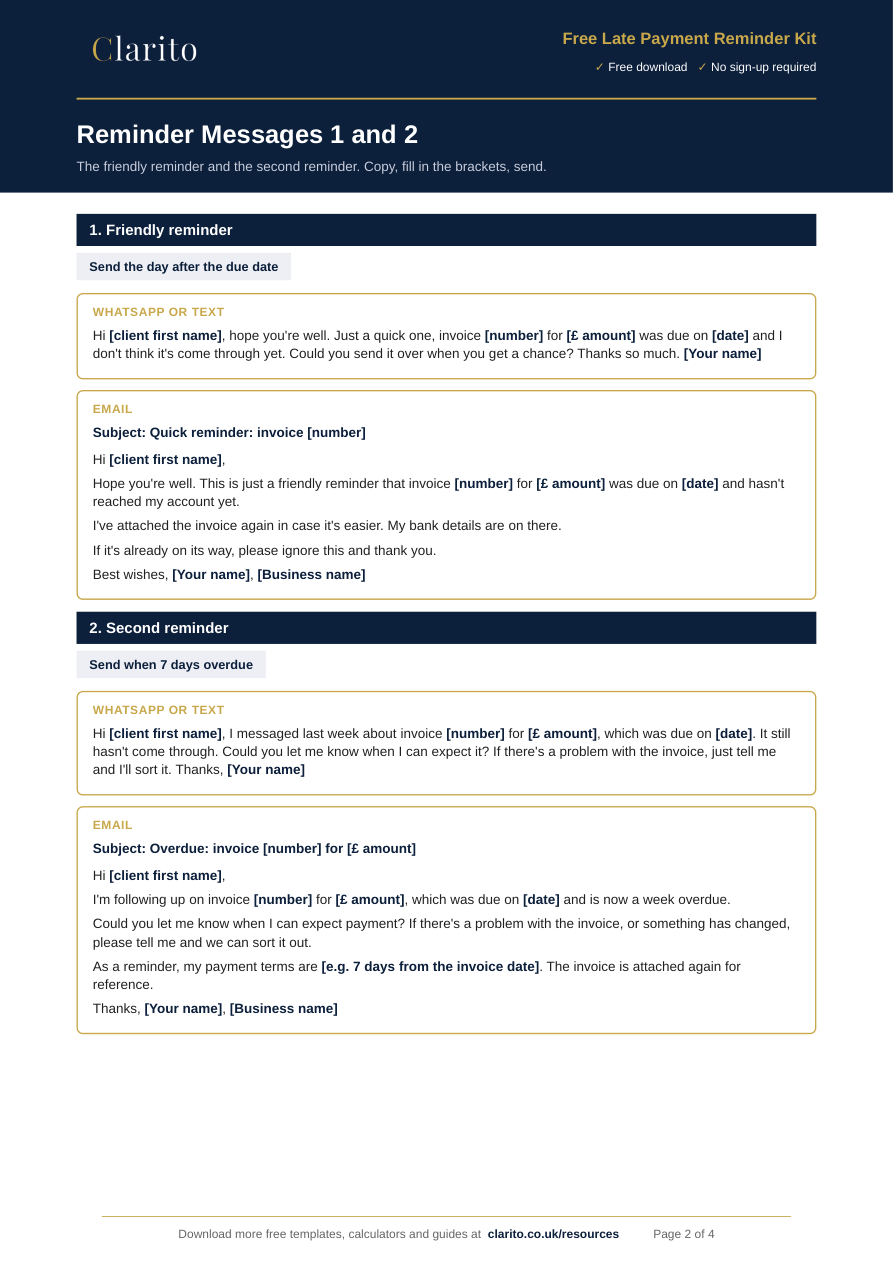
- Reminder messages 1 and 2
- Reminder messages 3 and 4
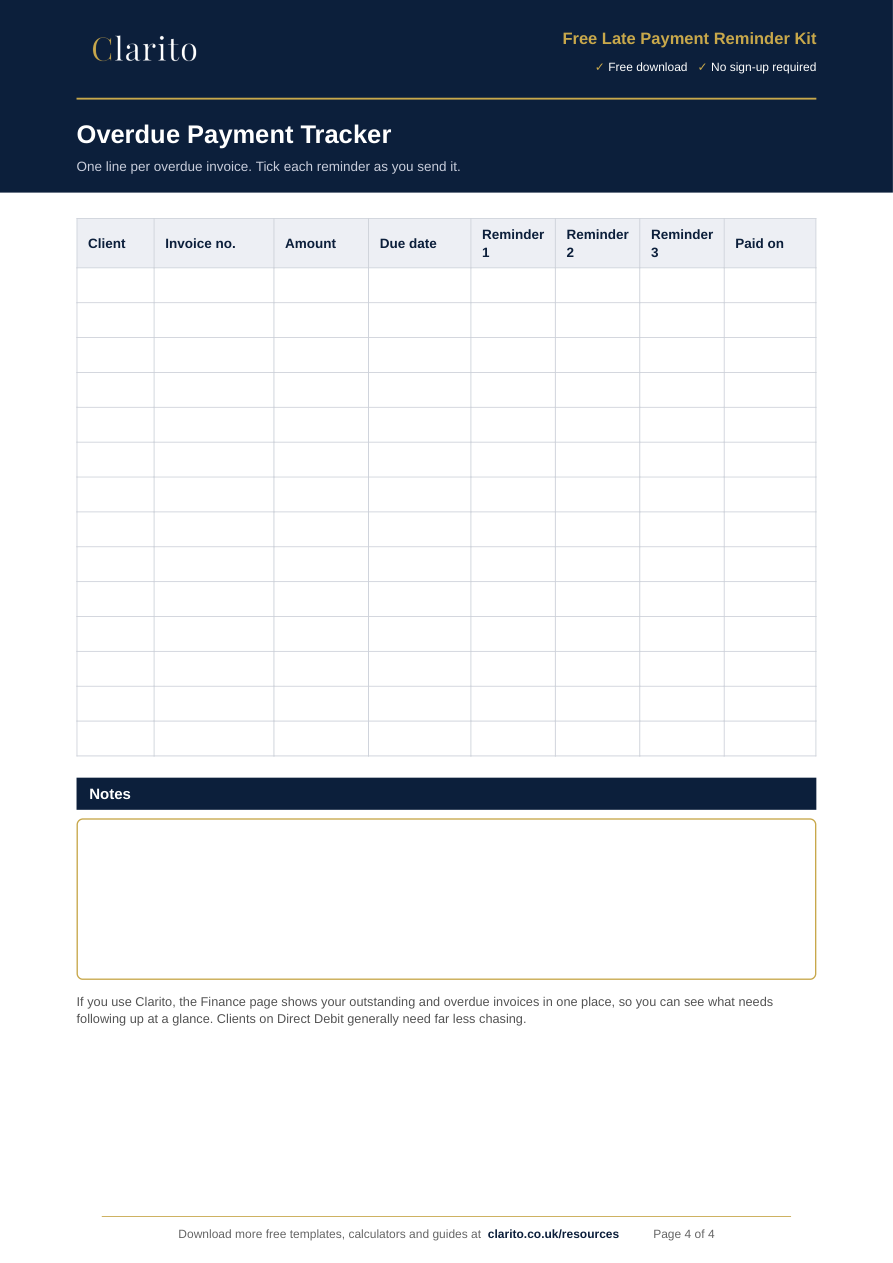
- Overdue payment tracker
Why Chasing Feels So Hard
Most self-employed cleaners have a good relationship with their clients. You are in their home every week. You know their kids' names and where the cat hides. So when the payment does not arrive, asking for it feels like it might damage something.
It will not. Clients who pay late are usually not doing it deliberately. They forgot, they assumed it was on a standing order, or the invoice went into a folder. A polite reminder is a normal part of running a business and most clients respond to it without a second thought.
The cleaners who struggle are the ones who chase inconsistently: nothing for three weeks, then an awkward message that has clearly been rewritten five times. A fixed routine takes the emotion out of it.
The Routine
The kit is built around four messages sent at fixed points:
Day after the due date: friendly reminder. Assumes they forgot and gives them an easy way to put it right.
7 days overdue: second reminder. Still polite, but asks for a payment date and mentions your terms.
14 days overdue: final reminder. Clear that visits will pause until the account is settled.
After payment: thank you. Keeps the relationship warm and suggests Direct Debit so it does not happen again.
Adjust the gaps to match your own payment terms. If your invoices are due in 7 days, the first reminder goes on day 8. What matters is that the gaps are fixed and you stick to them.
What Makes a Good Reminder
The messages in the kit follow a few simple rules.
Always include the specifics. The amount, the invoice number and the original due date. There should be no doubt which payment you mean.
Do not apologise for asking. "Sorry to bother you" tells the client the payment is optional. It is not.
Escalate gradually. The first message assumes a mistake. The second asks for a date. The third gives a consequence. Jumping straight to the consequence damages the relationship; never getting there costs you money.
Sound like yourself. Send them from your usual number or email, in your usual tone. A cleaner who suddenly starts writing like a debt collection agency is jarring.
The Final Reminder Has to Be Final
The third message says that visits will pause until the account is settled. If you send it, you have to mean it.
A final reminder that is not final teaches the client that your deadlines do not mean anything, and the next late payment will be later. Pausing a visit is uncomfortable, but it is the moment most persistent late payers decide it is easier to just pay.
The message is written to keep the door open: "As soon as it comes through I'll get you back in the diary."
When a Client Says They Have Paid
Check your bank first, including the last two working days, as transfers occasionally take time. If it still is not there, reply simply and ask them to check which account it went to. Most of the time it went to the wrong place or was never actually sent.
Take the Chasing Out Altogether
Every message in this kit exists because a client had to remember to pay. Direct Debit removes that step. The client agrees once, and after that each invoice can be collected automatically. No remembering to make the payment each time, and far less chasing.
The thank-you message in the kit is written to suggest it, because a client who has just paid late is the client most likely to say yes.
Download the Free Late Payment Reminder Kit
Our free Late Payment Reminder Kit is designed specifically for UK self-employed cleaners.
It includes:
- A guidance page on chasing payments
- Four messages in WhatsApp and email versions
- An overdue payment tracker
Looking for a Digital Alternative?
If you would rather not chase payments at all, Clarito is designed specifically for UK self-employed cleaners. With Clarito you can:
- Set clients up on Direct Debit so payments are collected automatically
- Invoice after each visit or once a month for weekly clients
- See every outstanding and overdue invoice on one Finance page
- Keep client details, jobs, quotes and invoices in one place
Clients on Direct Debit generally need far less chasing.
Frequently Asked Questions
How long should I wait before chasing a late payment?
Send the first reminder the day after the due date. Waiting longer signals that the due date was not really a due date.
Can I charge interest on a late payment?
For domestic clients, this is rarely worth the relationship cost, and the rules on statutory interest apply to business-to-business work. A clear cancellation and payment policy in your service agreement is a much more effective tool.
What if a client never pays?
If an invoice remains unpaid after you have followed your normal reminder process, make sure you understand your options before taking further action. For most cleaners the practical answer is to stop working for that client, and to move remaining clients onto Direct Debit so the problem does not repeat.
Should I keep cleaning while I chase?
Up to the final reminder, yes. After the final reminder, pause until the account is settled. Continuing to work for a client who is not paying just increases the amount you are owed.
Related Resources
Download the free Late Payment Reminder Kit or try Clarito free during testing.
Download Free KitAbout the author
Written by Clarito. Clarito builds software designed specifically for UK self-employed cleaners. We publish practical guides, free templates and business resources to help cleaners save time and stay organised.