Key Holding Agreement Template for Cleaners (Free UK Download)
Holding a client's keys is the moment they decide to trust you completely.
It is also the moment you take on real responsibility: for their property, their security, and for what happens if a key goes missing. Usually it all goes fine. But “it usually goes fine” is not a system, and the one time it does not, you want a record of what you held, what you agreed and what you did about it.
This free kit gives you a one-page key holding agreement to complete with the client, and a key register for your own records.
At a Glance
Inside the free Key Holding Kit you'll find:
- A one-page guide to handling keys well, what to do if one is lost, and your data protection responsibilities.
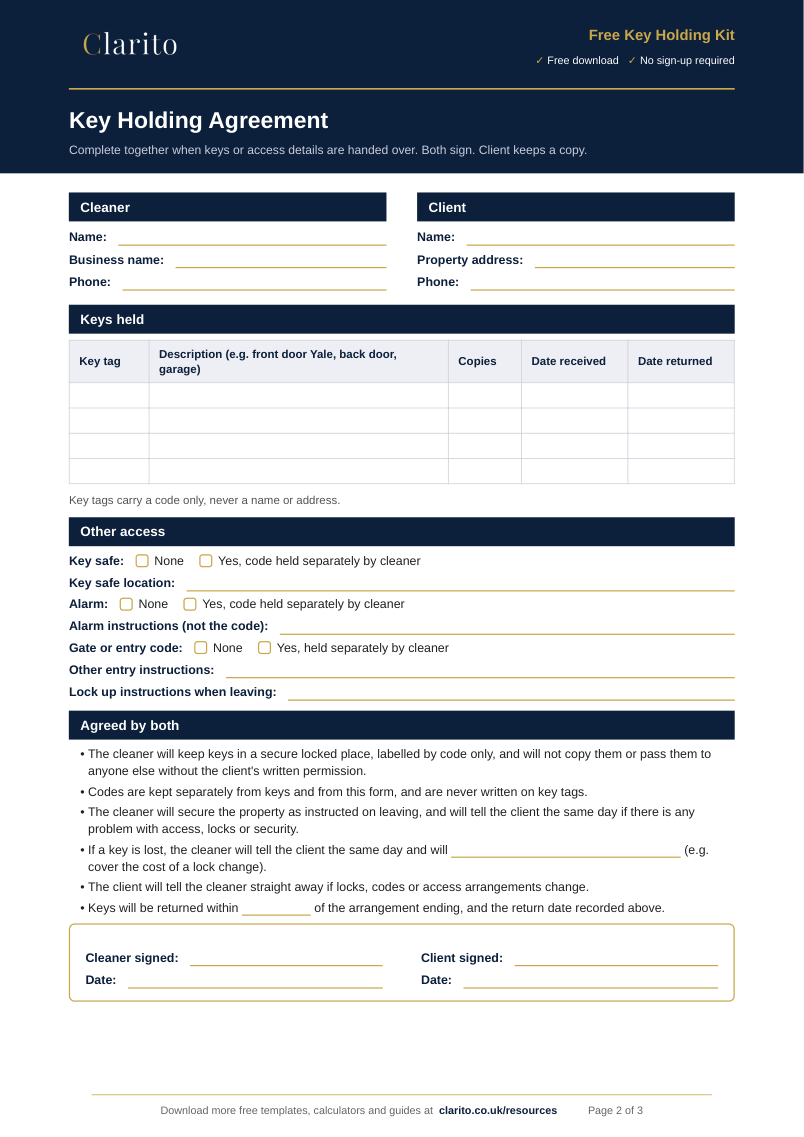
- A Key Holding Agreement to complete and sign with the client.
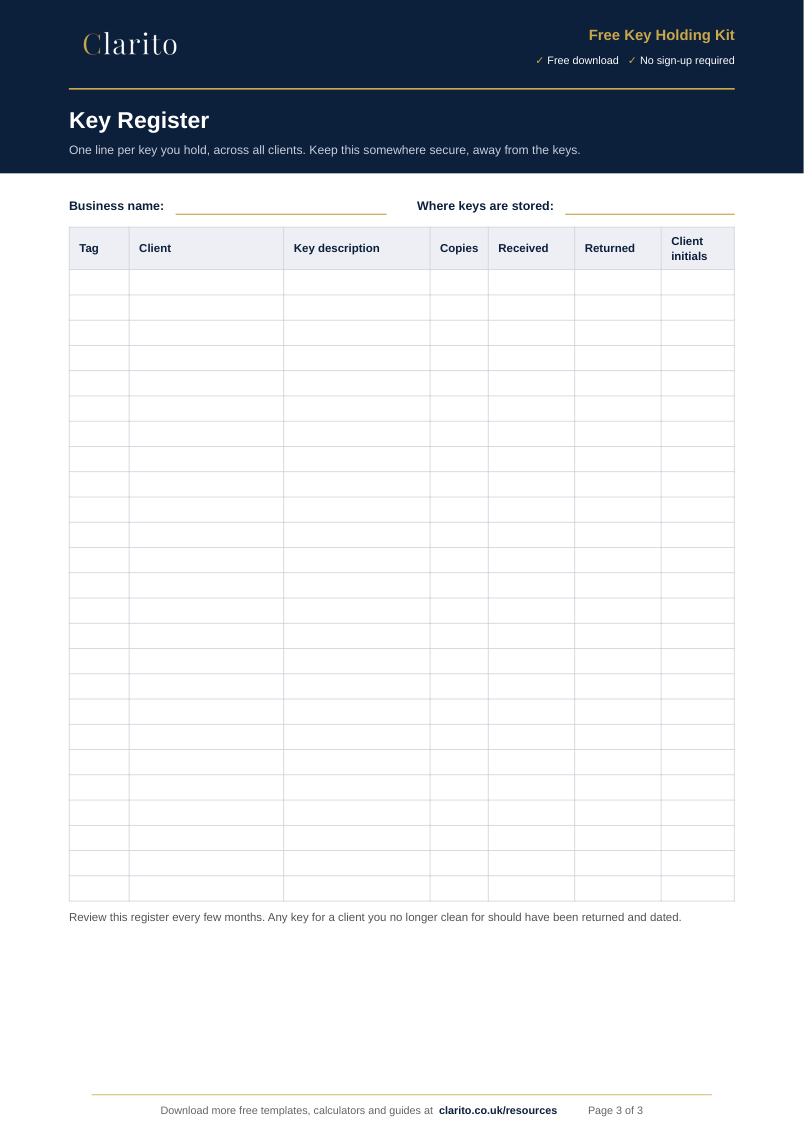
- A Key Register for your own records, with one line per key across all clients.
- A printable format designed for UK self-employed cleaners. No sign-up required.
Free Download
Download the Free Key Holding Kit
No sign-up required. Complete the agreement with the client when keys are handed over, and keep the register somewhere secure at home.
Why a Key Holding Agreement Matters
It records what you hold: which keys, how many copies, when you received them and when you returned them. There is no confusion later about whether you still have the back door key.
It sets out how you look after them. Written down, agreed and signed, it reassures the client and protects you.
It says what happens if something goes wrong, before it does. You can agree who tells whom and who pays for what.
Some insurers may ask how you manage keys. A signed record for every key you hold is a useful record to have.
What the Agreement Covers
- Cleaner and client details, including names, property address and contact numbers.
- Keys held, with a tag code, description, number of copies, date received and date returned.
- Other access arrangements, such as a key safe, alarm, gate or entry code. The form records that a code exists and is held separately; it does not record the code itself.
- Lock-up instructions for what the client wants you to do when you leave.
- Six plain-English commitments covering secure storage, copying, separate code storage, securing the property, reporting a lost key and returning keys when the arrangement ends.
- Space for both signatures.
Keep Codes Away From Keys
This is the single most important habit, and it is why the agreement is designed the way it is. A key tag with an address on it, or a form with an alarm code next to the address, turns a lost key into a security risk.
- Tag every key with a code only, such as K01 or K02. Never use a name, address or anything that identifies the property.
- Keep alarm, key safe and gate codes somewhere separate from the keys and from any document with the address on it.
- Store keys in a lockable box or safe at home, not in the car or on a hook by the door.
If you use our Client Information Form, you will see it has space to record access codes. Keep a completed client form somewhere secure and separate from the keys themselves.
If a Key Is Lost
Tell the client the same day, even if you think it will turn up. Offer to cover the cost of a lock change if the key cannot be found. Check your insurance policy now, not after: some public liability policies cover lost keys and lock replacement and some do not.
Your Data Protection Responsibilities
Client names, addresses and access details are personal data. Keep completed forms secure, record only what you need, and destroy them when you no longer hold that client's keys.
Depending on how you process personal data, you may need to register with the Information Commissioner's Office (ICO). Their guidance for small businesses is short and worth reading.
Download the Free Key Holding Kit
Our free Key Holding Kit is designed specifically for UK self-employed cleaners. It includes a guidance page on handling keys, a Key Holding Agreement to sign with each client, and a Key Register for your own records.
Looking for a Digital Alternative?
If you would rather keep access details with everything else about a client, Clarito is designed specifically for UK self-employed cleaners. With Clarito you can:
- Store access notes on each client's record.
- Have them on your phone at every visit.
- Keep them alongside the client's schedule, jobs and invoices.
You never have to ask twice, and there is no paper file to lose.
This article is general information, not legal advice or a substitute for your insurance terms.
Related Resources
Frequently Asked Questions
Do I need a written agreement to hold a client's keys?
No. But it records what you hold and what you have agreed, which protects both of you. Many clients feel more comfortable handing over keys when there is something in writing.
Should I write the alarm code on the form?
No. Record that a code exists and that you hold it separately. Keep the code itself somewhere with no address attached.
What should I do with keys when a client leaves?
Return them promptly, in person or by recorded delivery, write the return date on the agreement and the register, and ask the client to initial it.
Does my insurance cover lost keys?
It depends on the policy. Some public liability policies include cover for lost keys and lock replacement; some exclude it or offer it as an add-on. Check before you need to.
Do I need to register with the ICO?
Possibly. It depends on how you process personal data. The ICO has a short self-assessment on its website that tells you.
Related Resources
Download the free Key Holding Kit or try Clarito free during testing.
Download Free KitAbout the author
Written by Clarito. Clarito builds software designed specifically for UK self-employed cleaners. We publish practical guides, free templates and business resources to help cleaners save time and stay organised.